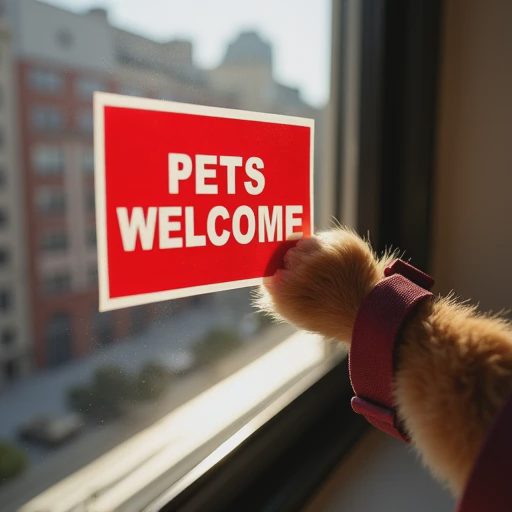
If you’ve spent any time hunting for an apartment in New York with a dog or cat, you’ve already learned the hard way: the words “pets welcome” on a listing are about as reliable as a subway announcement in the rain.
I’ve shown hundreds of apartments. I’ve watched people get excited by those two little words, only to find out three emails later that the building actually has a hard 25-pound limit, a “no dogs on the 4th floor” rule, or a landlord who changed his mind last Tuesday. The phrase is marketing, not a promise. So today I’m going to show you how I actually read a listing when a client has a pet.
1. Ignore the headline. Start with the fine print.
Most agents (myself included) put the good-sounding language at the top. “Pets welcome!” “Pet-friendly building!” “Dogs OK!”
Scroll past it. Look for the actual policy language, which is usually buried near the bottom or in the “additional information” section. You’re looking for specifics:
Weight or breed restrictions
Number of pets allowed
Whether cats and dogs are treated differently
Any mention of “owner approval” or “case-by-case”
If the listing only says “pets welcome” and nothing else, that is not a green light. That is an invitation to ask more questions.
2. The three most common traps I see every week
Trap A: “Pets welcome” that only applies to the current tenant’s pet.
Some buildings allow the people already living there to keep their animals, but new tenants are under a different (stricter) rule. Always ask: “Does this policy apply to new leases?”
Trap B: The soft “no” dressed up as a yes.
You’ll see language like “pets considered” or “pets on approval.” Translation: the landlord or board gets final say, and they can say no for any reason (or no reason). This is extremely common in co-ops and some condos.

Trap C: The missing pet rent or deposit.
A listing that doesn’t mention extra fees doesn’t mean there aren’t any. Many landlords decide the pet rent after you’ve fallen in love with the place. Ask early: “Is there a monthly pet rent or a one-time pet deposit?”
3. What I actually look for when I open a listing
Here’s my personal checklist, the same one I use when I’m screening places for clients who have dogs or cats:
Does the listing name a specific weight limit? (If it says “under 25 lbs” and your dog is 28, move on unless you’re ready to negotiate hard.)
Is there any mention of breed restrictions? (Even if your dog isn’t on the list, the existence of a list tells you the building is cautious.)
Does it say “cats only,” “dogs only,” or “pets”? Vague language is a yellow flag.
Is the building a walk-up or elevator? (This matters more than most people realize for larger dogs or older pets.)
How close is the nearest dog run or green space? I keep a running mental map of this for every neighborhood I work in.
Is there a doorman or live-in super? Their attitude toward pets can make daily life much easier or much harder.

4. The exact questions I teach my clients to ask
When you email or message the listing agent, don’t just say “Is this pet-friendly?” You’ll get a vague yes. Instead, try something closer to this:
“Hi, I’m interested in the apartment and I have a [age]-year-old [breed/size] who is [spayed/neutered, crate-trained, etc.]. Could you confirm the building’s current pet policy, including any weight or breed limits, pet rent or deposit, and whether approval is required from the owner or board? Thank you.”
That short paragraph does two things: it shows you’re a serious, responsible pet owner, and it forces a more specific answer. Vague answers at this stage are useful information — they usually mean the policy is flexible or that the agent doesn’t actually know.
5. A quick reality check on neighborhoods
Some parts of the city are simply more open to pets than others right now. Brooklyn (especially certain parts of Bushwick, Bed-Stuy, and Prospect Heights) and parts of Queens tend to have more true “yes” buildings than many corners of Manhattan. That doesn’t mean Manhattan is impossible — it just means you need to read more carefully and be ready to move faster when a real yes appears.
I’ll be writing a more detailed neighborhood breakdown soon. For now, just know that “pets welcome” in one zip code can mean something very different in another.
The goal isn’t to make you suspicious of every listing. It’s to help you stop wasting emotional energy on places that were never going to work, so you can focus on the ones that might.
A listing that says “pets welcome” is the beginning of a conversation, not the end of one. Read it the way an agent does, ask the specific questions early, and you’ll save yourself a lot of heartbreak (and a lot of application fees).
Next time we’ll talk about what to do when the landlord says no — and the email that sometimes changes their mind.
Until then,
Maren
A home that fits all of you — tail included.

No notes yet — write the first one.